Building a Smart Tourism Village: How AI Can Help Small Towns Compete in Global Tourism
Japan's tourism villages face labor shortages, concentrated overtourism, and language barriers. AI concierge technology can help communities capture more value from the tourism boom, and there are government funding pathways to make it happen.
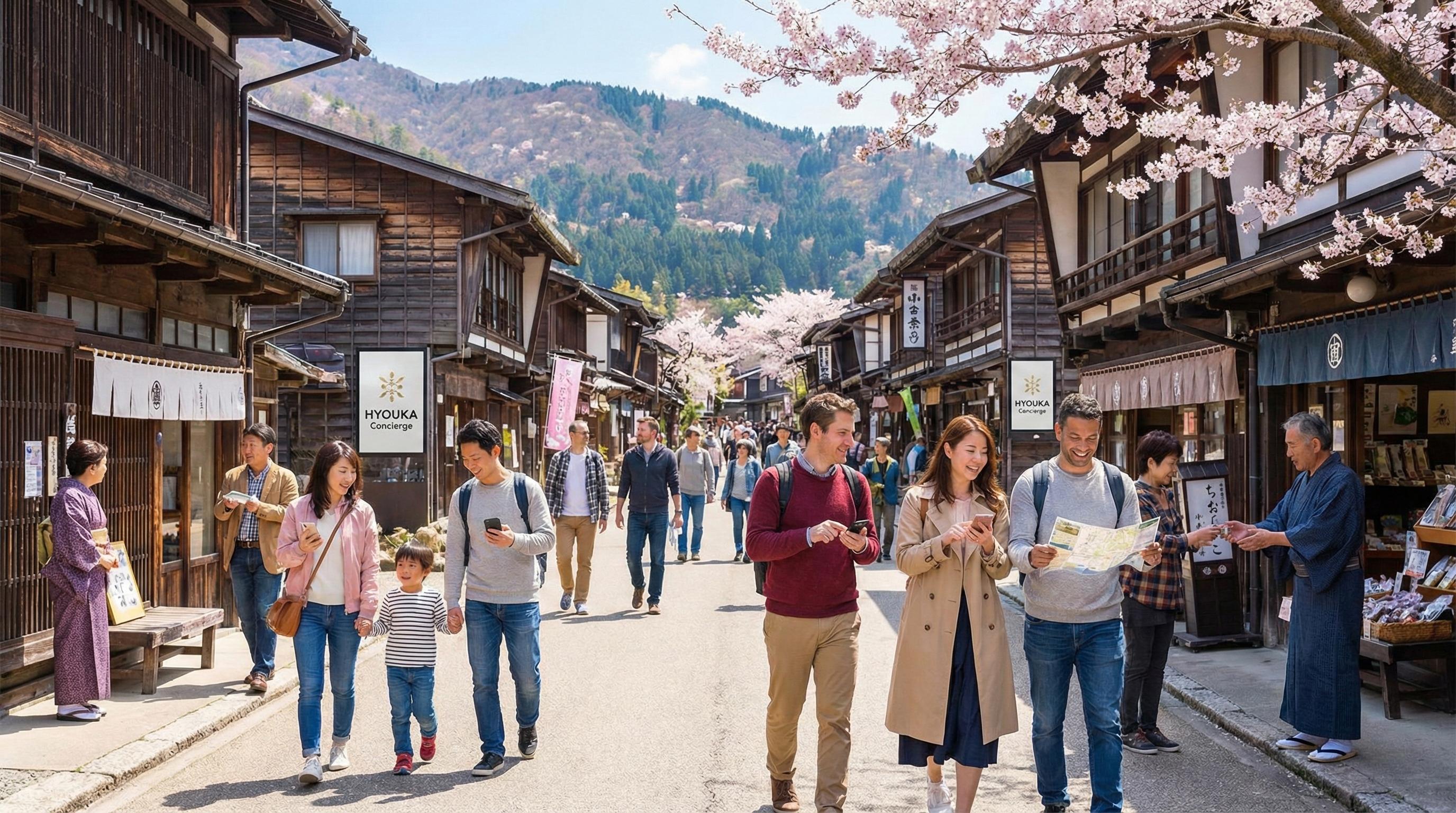
Japan welcomed a record 42.7 million international visitors in 2025, with total spending of ¥9.5 trillion (Japan Times). Most of that spending concentrates in Tokyo, Osaka, and Kyoto, while many communities with a lot to offer struggle to benefit.
The reasons include too few staff, too many language barriers, and many tourists simply don't know what's available in smaller towns. Visitors follow the highest-rated destinations on global platforms, unable to discover what local Japanese businesses would actually love to share with them.
This article explores the challenges facing tourism villages, how a modern AI concierge can address them, and practical pathways for getting started, including government funding programs designed specifically for this purpose.
The Challenges Facing Tourism Villages
The Labor Shortage
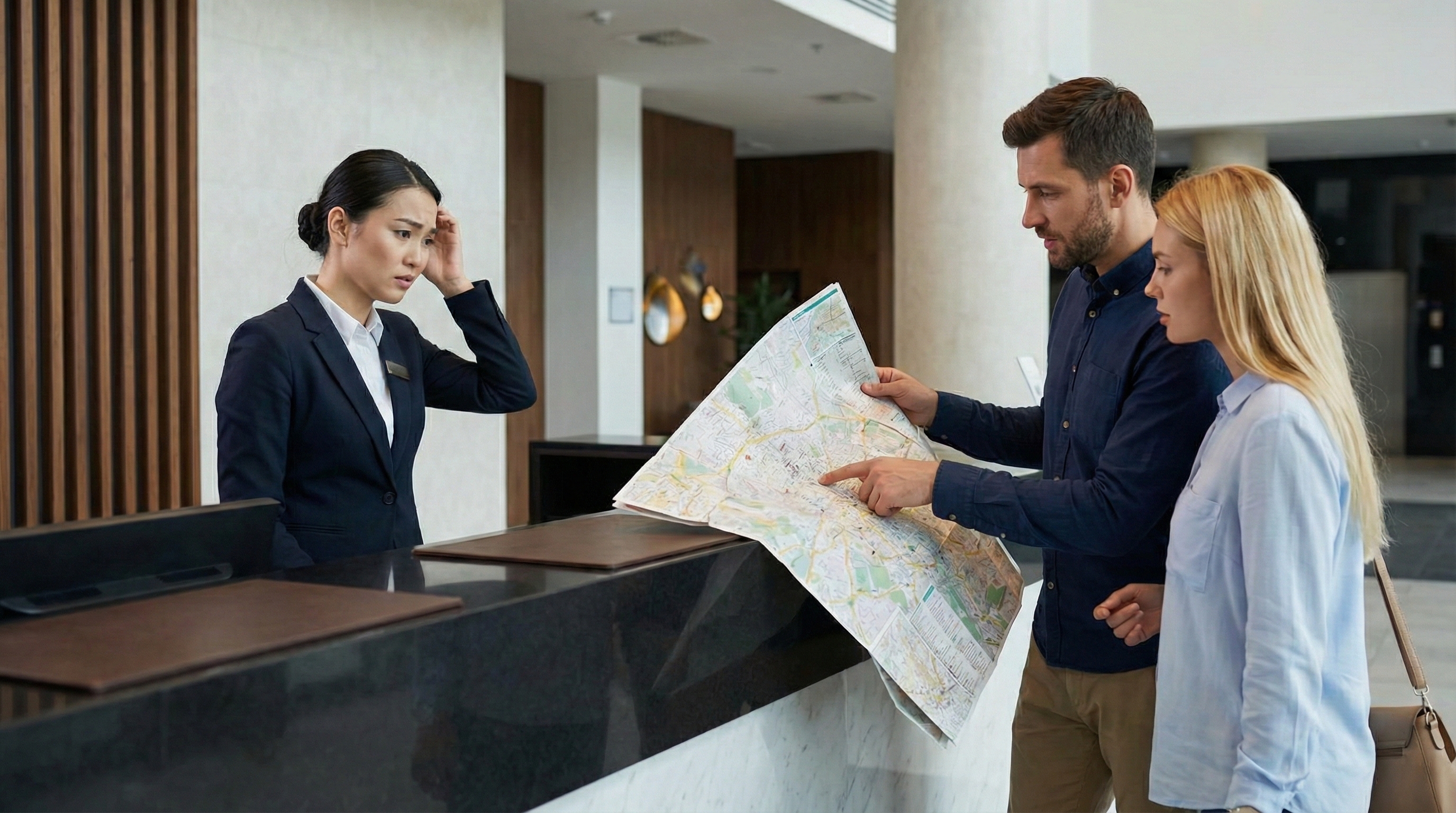
Japan faces a projected 29% workforce shortfall in hospitality by 2035. Villages are hit hardest. Younger people tend to stay in larger cities, leaving rural areas with an aging and shrinking workforce. Often the village businesses can't find staff with strong enough language ability.
Most rural tourism queries are repetitive and predictable. "Where is...?", "What time...?", "How do I...?" questions make up roughly 80% of all tourist inquiries at information centers - exactly the kind of work AI handles well.
Concentrated Overtourism
Within popular destinations like Kyoto, Kamakura, or Hakone, most tourists pack into the same few places. Meanwhile, equally beautiful spots just 15 minutes away sit completely empty. Tourists follow the most popular routes: the ones with the most reviews, the most Instagram photos, and the highest Google rankings.
Policy shift: The Japan Tourism Agency (JTA) has officially shifted its policy from "more visitors" to "better distribution" (WEF). But static signs and printed brochures can't change real-time behavior. What's needed is a way to actively guide people toward quieter alternatives at the moment they're deciding where to go next.
Revenue Leakage: Money Leaves the Village
A significant portion of tourism spending flows to large hotel chains, international booking platforms, and transportation companies headquartered in major cities. The local bakery, the family-run izakaya, and the artisan workshop often see little of the tourism dollar.
Why local businesses struggle to capture global tourism value
- Communication barriers with international visitors
- Offerings are not updated, translated, or catered toward global tourism
They aren't listed on platforms that international tourists use
International tourists tend to give more frequent and higher ratings on platforms like Google. This creates a cycle where the places already attracting overseas visitors gather better reviews, which in turn attract even more visitors. Local businesses that only serve domestic customers are left out of this cycle.
International visitors also tend to have higher spending power. Businesses that can communicate and market to a global audience often see significantly higher revenue per customer compared to those relying solely on domestic tourism.
Additional Friction Points in the Village
- Translation gaps: Information desks, transportation systems, hotel check-in forms, restaurant menus, and museum descriptions are often Japanese-only
- No personalized guidance: Visitors don't know about the village's best-kept secrets and self-guided exploration is difficult without local context
- Events go unnoticed: Local festivals, seasonal specials, and cultural events happen without tourist awareness because there's no channel to reach them
What Is HYOUKA Concierge?
HYOUKA Concierge is an AI concierge built for tourism and events. Here's what it offers at a glance:
- No-download web app - Instant app-like experience via QR or link
- Works in 30+ languages - natural conversation, not machine-translated menus
- Interactive maps and schedules - not just text replies
- Can be made to connect to local services, bookings, transport, and more
- Staff tools included - helps your team translate and communicate with visitors
- Real-time voice translation - staff can communicate with visitors directly
Unlike simple chatbots that give scripted answers, HYOUKA Concierge understands context, shows interactive content, and is designed to be the village's always-on, multilingual front desk.
Example Use Cases
Use Case 1: Getting to the Village
A tourist arrives at the nearest train station and needs to get to the village. They spot a QR code on a poster and scan it. They ask in their language: "How do I get to [village name]?" The AI tells them there's a bus leaving in one hour from platform 3 and also provides local taxi company phone numbers as an alternative. All in their native language, at 9 PM, when the information desk is closed.

Use Case 2: Discovering the Shopping Street
A visitor stumbles into a traditional shotengai (shopping street). There are dozens of shops, but they have no idea what's inside each one. They scan a QR code at the entrance and chat with the AI: "I'm looking for traditional crafts and local snacks." The AI narrows it down, suggests three shops that match, shows their locations on a map, describes what each is known for, and mentions that one has a pottery-making experience available today.
Use Case 3: Helping the Front Desk
A ryokan staff member has a guest asking about check-out procedures, nearby hiking trails, and luggage forwarding services, all in Korean. The staff member opens the AI on their phone, types the guest's questions, and gets clear answers and translations to help the visitor. The real-time voice translation feature also helps staff communicate directly with visitors face-to-face.
How AI Concierges Have Evolved
While AI chatbots and travel guides have been around for a while, only recently has the technology become smart enough to offer a full "concierge" experience. Understanding the three generations helps you see the difference.
Gen 1: Menu Bots (2015-2020) | Gen 2: Chatbots (2020-2024) | Gen 3: Smart AI Concierge (2025+) | |
|---|---|---|---|
Input | Tap predefined buttons | Free-text questions | Text, photos, voice, location context |
Output | Static menu paths | Text-based answers | Dynamic UI: maps, schedules, booking buttons |
Behavior | Rigid, no personalization | Waits for questions, gives answers | Proactive - suggests, plans, and acts |
Local Data | Rigidly defined hierarchical answers | Static knowledge base | Live feeds: shop status, transport, weather, events |
Language | 1-2 languages, manual translation | Machine-translated text | Natural conversation in 30+ languages |
Integration | None | Limited API connections | Can connect to bookings, transport, POS systems |
Gen 1 gives you options like "See bus schedule" and works like a basic app or website.
Gen 2 can answer some pre-trained questions but requires heavy manual setup and constant updates.
Gen 3 handles natural, complex questions. It checks real-time information across multiple sources and builds a personalized response including interactive visuals, and adjusts if conditions change.
Why a dedicated AI concierge beats generic AI tools: Many tourists already use ChatGPT, Google Gemini, or similar tools when traveling. But these general-purpose tools lack up-to-date, curated local information and can provide wrong or outdated answers. A dedicated AI concierge performs better because it's connected to local data sources, not trained on last year's internet. Furthermore, the concierge can connect to other systems and show customized views such as maps or menu cards.
Benefits for Visitors, Businesses, and the Village
The value of an AI concierge flows in three directions at once.
For Visitors
- Multilingual AI chat - get help in your own language, anytime, without waiting for staff
- Interactive area map - explore the village confidently, discover hidden spots
- Custom itinerary planning - personalized suggestions based on time, interests, and group
- Real-time local information and events - what's open, what's crowded, festivals, markets, seasonal experiences, and special offers, all automatically translated
- General information and guidance - understand local systems like bus routes, Shinkansen transfers, takkyubin luggage services
- Japanese manners and simple phrases - learn basic Japanese and cultural tips to build better connections
- Safety alerts - receive earthquake/typhoon guidance in your language
- Reservations - reservation systems can be integrated, allowing booking of restaurants, experiences, and transport
For Local Businesses
- Translation bridge - serve international customers without hiring multilingual staff
- Connect to local services - taxi companies, tour providers, and restaurants can reach tourist audiences
- Promotions and coupons - fill empty tables, promote flash sales, drive foot traffic with targeted offers
- Reduced staff burden - tourists solve common issues themselves, freeing staff for personal service
- Staff support tools - help your team translate and provide information to foreign guests
- Visitor surveys - get structured feedback from international customers
For the Village / Municipality
- No-download, browser-based access - app-like experience without app store friction, instant adoption
- Crowd distribution tools - guide visitors to less crowded areas, manage concentrated tourism
- Marketing and discovery engine - promote hidden gems and encourage exploration of new areas
- Visitor data and analytics - understand what tourists ask, where they go, and what they need
- Event management - easily deliver local events and seasonal content to tourists
- Survey integration - collect visitor experience data to justify budgets and improvements
- Safety channel - deliver safety instructions and emergency communication to foreign visitors
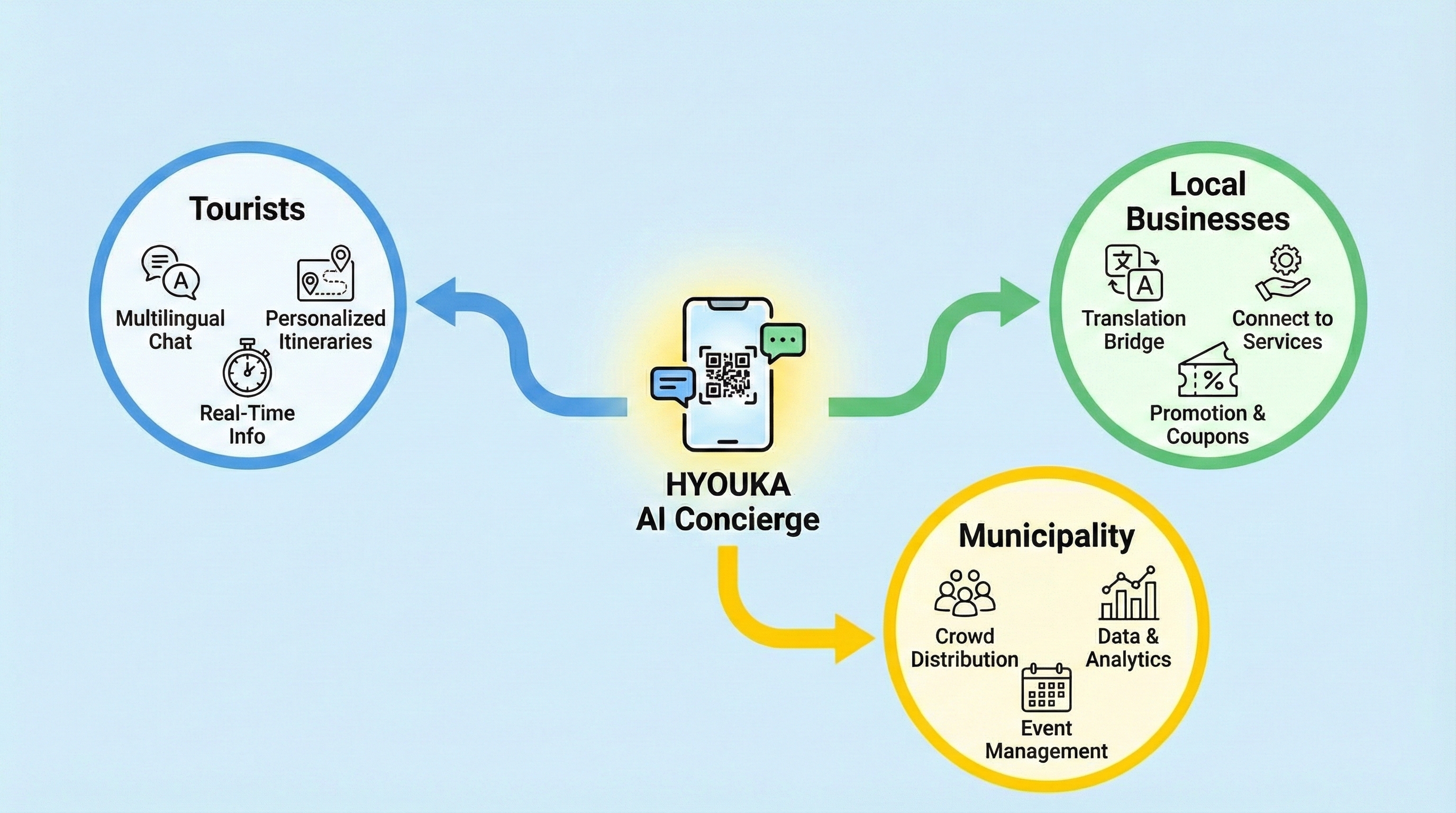
How an AI concierge connects visitors, local businesses, and the municipality
For DMOs and Tourism Associations: Funding and Getting Started
You don't have to fund this alone. The Japanese government has created several programs designed for this kind of digital infrastructure.
- Digital Garden City Nation Grant - The municipality applies and includes the AI concierge as part of its digital infrastructure plan. Prioritizes labor-saving, data-generating solutions for regional revitalization. Applications typically open in Spring.
- Digitalization & AI Subsidy - A consortium of 10+ local businesses (shops, ryokans, restaurants) applies together through a Tourism Association or DMO. The AI platform goes live across all members at once. Applications expected from late March 2026.
- Tourism Demand Dispersal Grant - Government grants focused on distributing tourism demand to lesser-known areas. Supports projects that help spread visitors beyond concentrated hotspots.
Two Paths to Partnership
Path A - Your organization reaches out. You identify the need, contact us, and we work together to assess needs, design a pilot, identify the best funding vehicle, and co-write the application.
Path B - We find the opportunity. We monitor active grant and challenge briefs. When a match appears, we reach out with a tailored proposal, demo the technology, collaborate on the application, and run a subsidized pilot.
🚀 Let's Build a Smarter Village Together
Whether you're a DMO exploring digital tools, a municipality considering grant applications, or a tourism association looking to support local businesses, we'd love to talk.
![[Health Ingredients Japan 2026] Datailo’s AI Concierge Introduced! Making Exhibition Research and Planning More Convenient](/_next/image?url=https%3A%2F%2Fdatailo-website.s3.ap-northeast-1.amazonaws.com%2Fimages%2Fcovers%2Fhi-japan-2026-ai-concierge.jpg&w=3840&q=75)