2025 Customer Experience Trends for Brick-and-Mortar Retail
Physical retail holds 85% of sales — but CX expectations have evolved. From phygital experiences to AI personalization, here are the trends shaping in-store customer journeys.
In 2025, while e-commerce continues to expand, the majority of customers still prefer in-store shopping. Many consumers review products and search for items online, but they also want to experience the product firsthand in-store.
However, the expectations of in-store shoppers have evolved. Today's consumers seek more than just products; they look for immersive and personalized experiences. This experience should transition seamlessly from online to in-store, a concept often referred to as the omnichannel experience.
As customers become more demanding, retailers must focus on delivering a smooth, satisfying customer experience (CX) to retain them and increase the lifetime value (LTV) of the customers. Utilizing innovative technologies to gather real-time customer feedback allows retailers to make data-driven decisions, enhancing both CX and overall customer satisfaction.
📊 Key Retail Stats for 2025
- 85% of total retail sales are expected to come from brick-and-mortar stores
- 76% of customers still prefer in-store shopping
- 50% of shoppers will switch to a competitor after just one bad experience, and 80% after two or more
📋 In This Article
- Customer Experience Trends in Retail in 2025
- In-Store Experience Trends
- Data-Driven Decision Making for CX
- AI-Enhanced Surveys: The Future of In-Store Feedback
Customer Experience Trends in Retail in 2025
The retail landscape in 2025 is shaped by several key trends that enhance customer experiences. These include the rise of phygital retail, sustainability, AI-powered personalization, contactless payments, and data-driven decision-making.

1. The Rise of Phygital Retail
Phygital retail (the blending of physical and digital shopping experiences) remains a key trend. Consumers often research and read product reviews online before visiting a store for experiencing the product first-hand.
Retailers are using digital tools like AR try-ons, mobile apps, and smart mirrors to provide a seamless shopping journey that integrates online convenience with in-store engagement.
95% of shoppers review products online, and 58% are willing to pay more for items of a brand with good reviews. Brick-and-mortar store openings result in a 7% increase in online sales, with 9% higher basket sizes for customers who shop both online and in-store.
2. Sustainability and Ethical Retailing
Sustainability continues to be a significant driver for retail success, particularly among younger consumers. Retailers are adopting eco-friendly practices like waste reduction, sustainable packaging, and ethical sourcing to meet these demands.
These initiatives not only help the planet but also build long-term loyalty by aligning with the values of today's conscious consumers and increasing long-term brand loyalty.
27% of Gen Z and Millennial customers are more likely to purchase from brands that prioritize social and environmental causes.
3. AI-Powered Personalization
In 2025, AI is transforming customer experiences through hyper-personalization. AI tools analyze customer data in real time to provide personalized product recommendations, targeted offers, and optimized store layouts.
These solutions help retailers tailor their interactions to individual preferences, increasing satisfaction and lifetime value (LTV). Despite privacy concerns, customers are willing to try new AI-powered experiences.
AI Personalization Stat | Value |
|---|---|
AI decision-makers citing personalization as top use case | 42% |
Gen Z consumers who embrace AI for shopping | 65% |
4. Data-Driven Decision Making
Retailers are leveraging a data-driven approach to optimize in-store experiences and tailor their offerings to customer preferences. By analyzing vast amounts of customer data, retailers can make informed decisions that improve CX.
Data Analytics Impact | Value |
|---|---|
Orgs seeing positive impact on customer loyalty | 78% |
Orgs seeing positive impact on profits | 79% |
Sales growth with customer analytics | +50% |
Profit increase with customer analytics | +126% |
In-Store Experience Trends for 2025
In 2025, in-store experiences are increasingly immersive, personalized, and powered by advanced technologies like augmented reality (AR) and AI.
1. Phygital Stores: The Fusion of Physical and Digital
Phygital retail is transforming the way customers shop. Phygital stores integrate augmented reality (AR) try-ons, smart mirrors, and mobile apps to create a seamless shopping journey.
71% of shoppers are more likely to visit stores offering AR experiences, and 40% are willing to pay a premium if they can test a product using AR.
2. Immersive AR Experiences
In-store augmented reality is becoming a powerful tool for engaging customers. AR allows shoppers to visualize products in their own environments or try on items virtually, enhancing their shopping experience.
IKEA's Place app, for example, uses AR to help customers see how furniture would look in their own spaces. This technology empowers customers to make more informed decisions, leading to increased conversions.

3. The Role of Generative AI in Customer Experience
Generative AI is revolutionizing in-store interactions by creating personalized experiences. These systems enhance both customer and employee experiences, offering personalized product recommendations and enhancing the omnichannel experience.
In addition, AI-powered chatbots and virtual assistants provide instant customer support, helping with product information, item location, and checkout assistance.
78% of global executives have an approach to scale generative AI into customer and employee experiences.
4. Contactless and Frictionless Payments
The adoption of contactless and frictionless payments continues to rise in 2025, with retailers increasingly implementing near-field communication (NFC) technologies like Apple Pay and Google Pay. Biometric payment systems, such as facial recognition and fingerprint scanning, are also being introduced.
While these innovations enhance convenience, they also raise concerns around data security and privacy.
5. Personalized Customer Experiences Powered by Data
In-store technology now enables retailers to personalize experiences in real-time, such as bringing up a customer's cart on a digital screen or offering custom recommendations based on their shopping history.
Retailers are also giving customers the flexibility to control their shopping journeys through self-service kiosks, mobile apps, and BOPUS (buy online, pick up in-store) options.
Data-Driven Decision Making to Improve CX
1. Leveraging Data for CX Improvements
While businesses still base decisions on employee anecdotes or gut feelings, this approach often misses the mark. To get a complete and accurate understanding of customer behavior, companies must focus on collecting real customer opinions and building analytical systems.
The Perception Gap | Brands | Consumers |
|---|---|---|
"We offer personalized experiences" | 85% | 60% agree |
Companies that effectively use customer analytics report 50% higher sales and 126% more profit than those that do not.
2. Closing the Customer Experience Feedback Loop
For data-driven decision-making to be effective, the process of collecting, analyzing, and acting on data must be tightly connected. Retailers must gather data continuously and ensure feedback loops are constantly feeding into decision-making processes.
3. The Challenge of Gathering Customer Data
One of the biggest hurdles is collecting reliable, real-time customer data. Surveys and online reviews often reflect extremes: either highly satisfied or dissatisfied customers.
🤔 The Silent Majority Problem
- 96% of unsatisfied customers do not voice their opinions
- 80% of businesses believe they provide superior customer service, yet only 8% of customers feel they receive it
AI-Enhanced Surveys: The Future of In-Store Feedback

1. Retail AI Camera Systems
AI camera systems help improve store operations by monitoring customer flow, tracking demographics, and analyzing behavior. However, they do not collect direct customer opinions, limiting their effectiveness for understanding the full picture.
2. Introducing AI Camera-Enhanced Surveys
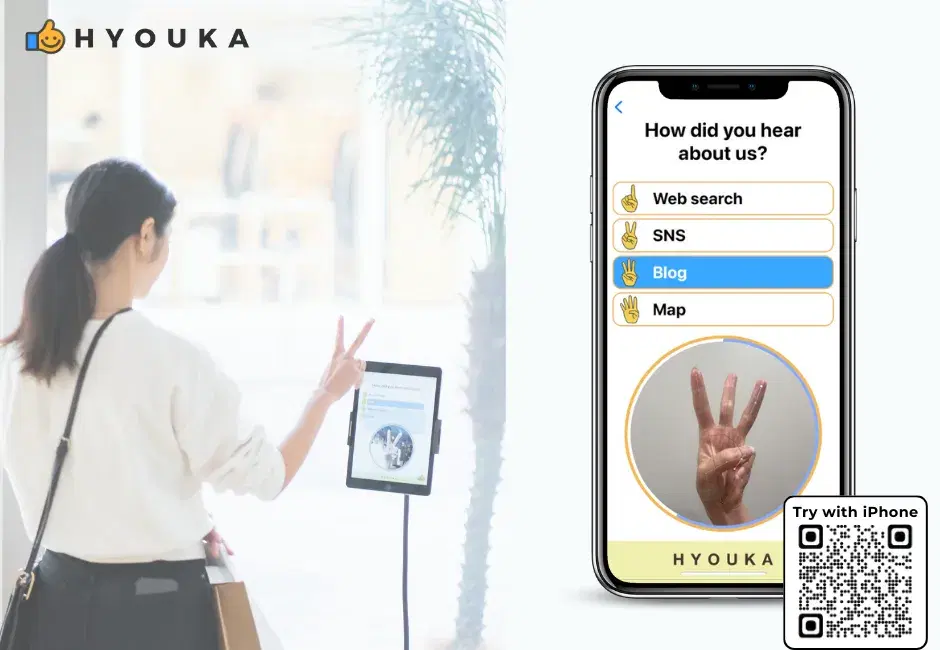
By integrating AI-powered camera technology with interactive surveys, retailers can gather real-time data in-store. This approach significantly boosts response rates and improves the survey experience by reducing the number of questions asked (as cameras gather demographics automatically).
3. HYOUKA: Revolutionizing In-Store Feedback
HYOUKA integrates real-time camera data with interactive surveys. It captures demographic information without saving images or compromising privacy. It supports omnichannel feedback by integrating in-store data with online surveys, QR codes, and NFC surveys.
✨ HYOUKA's Omnichannel Advantage
- In-store tablet surveys with AI camera demographics
- QR code surveys for on-the-go feedback
- NFC tap surveys for frictionless responses
- Real-time dashboards for instant analytics
Conclusion
In 2025, retailers must focus on providing immersive and personalized in-store experiences. Key trends like phygital retail, AI-driven personalization, and contactless payments are reshaping customer interactions. Retailers should adopt methods to gather diverse customer data and integrate it into actionable decision-making processes to optimize experiences and drive long-term loyalty.
References
- The Rise of Phygital Stores
- Evolution of In-Store Shopping
- 2024 Retail Trends
- Customer Service Statistics
- Bad Customer Service Impact
- Customer Experience Statistics
- Hyperpersonalization in CX
- AI-Enhanced Shopping Experiences
- CEO Generative AI Report
- Augmented Reality Retail Stats
- IKEA Place App
- Consumer Sustainability Demands
🚀 Transform Your In-Store Customer Experience
Use AI-powered surveys and real-time analytics to stay ahead of 2025 retail trends.